
Bunching Deductions: How to Beat the Standard Deduction Legally
You may give to charity, pay property taxes, and carry a mortgage, yet still get no extra tax break. That happens because the standard deduction is high enough to wipe out the value of many itemized deductions. Bunching deductions gives you a way to fix that timing problem. Instead of spreading deductible expenses evenly across tax years, you group them into one year so your itemized deductions rise above the standard deduction. Then you take the standard deduction the next year. This matters now because many taxpayers are stuck in the middle. They have real deductible costs, but not enough in any single year to itemize. If you plan ahead, especially with charitable giving, medical expenses, and certain tax payments, you may turn expenses you already planned to pay into a cleaner tax benefit.
What Changes When You Bunch Deductions
- You shift deductible expenses into one tax year to clear the standard deduction threshold.
- You itemize in the high-deduction year and take the standard deduction in the low-deduction year.
- Charitable giving is often the easiest expense to move without creating financial strain.
- Medical bills, property taxes, and estimated state taxes may also help, but the rules are tighter.
- The strategy works best when you plan before year-end, not while rushing through tax software in April.
How Bunching Deductions Works
The standard deduction is a flat amount the IRS lets you subtract from taxable income. Itemizing means you add up specific deductible expenses instead. You choose whichever gives you the larger deduction.
Here is the catch. If your itemized deductions fall just below the standard deduction, those expenses do not improve your federal tax result. You still take the standard deduction, and the extra receipts sit there like unused coupons in a drawer.
Timing is the whole play.
Think of it like cooking for the week. Making one dinner each night can work fine, but meal prep can save time because you group the work. Bunching deductions does the tax version of that, by moving deductible payments into one year where they count more.
The core idea is simple: make one tax year heavy enough to itemize, then let the standard deduction carry the next year.
Bunching Deductions Example With Real Numbers
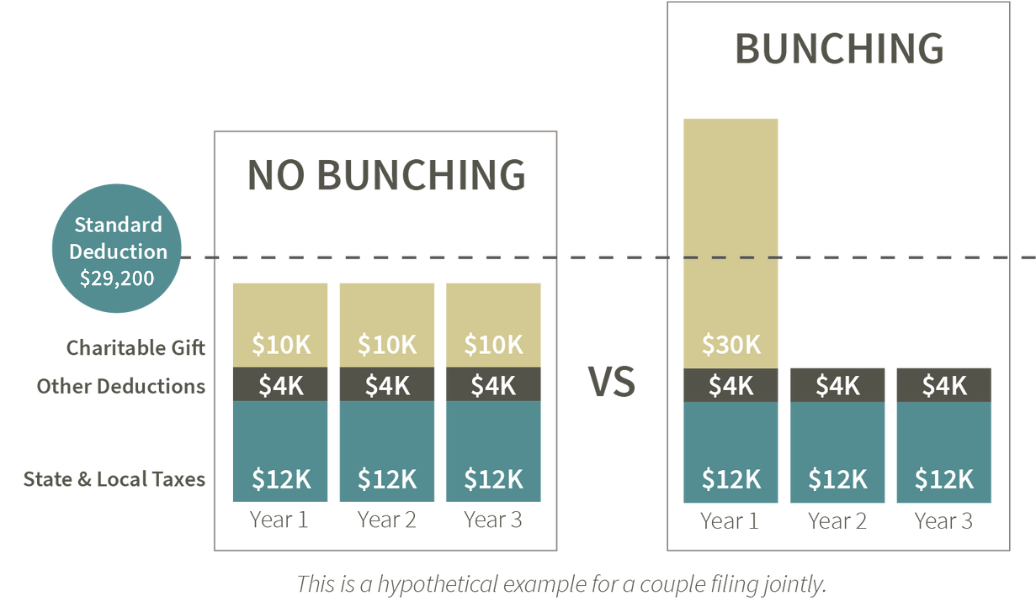
Say a married couple filing jointly normally has $24,000 in itemized deductions each year. Their total includes mortgage interest, state and local taxes, and annual charitable gifts. If the standard deduction is higher than that, they take the standard deduction and get no extra federal benefit from itemizing.
Now assume they move two years of charitable giving into one tax year. Instead of giving $5,000 each year, they give $10,000 in December of year one and skip the same gift in year two. Their itemized deductions may rise above the standard deduction in year one, while they take the standard deduction in year two.
Why donate in December if January gives you the same good feeling but a weaker tax result?
The tax savings depend on your bracket and how far your itemized deductions exceed the standard deduction. If bunching lifts your itemized deductions by $3,000 above the standard deduction and you are in the 22% federal bracket, the rough federal tax savings could be about $660. State tax results vary.
Best Expenses to Use for Bunching Deductions
Charitable donations
Charitable giving is usually the cleanest tool because you often control the timing. You can give cash, appreciated stock, or other eligible property to qualified charities. Keep receipts and confirm the organization is eligible under IRS rules.
A donor-advised fund can help if you want the deduction now but prefer to send grants to charities over time. You contribute to the fund in the bunching year, then recommend grants later. This can work well for people who give every year and want to avoid odd gaps for the nonprofits they support.
Medical and dental expenses
Medical deductions are harder because they must exceed a percentage of your adjusted gross income before they count. Still, if you already face a costly year, you may be able to schedule dental work, vision care, fertility treatments, surgery, or other eligible costs in the same tax year.
Do not create medical spending only for a deduction. But if your doctor says the timing is flexible, line up expenses in a year where you already expect high out-of-pocket costs. Your health comes first, then the tax math.
State, local, and property taxes
State and local tax deductions, often called SALT deductions, can help some taxpayers, but federal caps may limit the benefit. Property tax timing may also depend on your county’s billing system. Paying early only helps if the tax has been assessed and the payment qualifies under IRS rules.
This is where I push back on easy internet advice. Prepaying taxes is not magic. If the deduction is capped or the payment is not eligible, you may only drain cash from your bank account sooner.
Who Should Consider Bunching Deductions?
Bunching works best if your itemized deductions are close to the standard deduction. If you are far below it, you may need a large shift to make itemizing worthwhile. If you already itemize every year, bunching may still help, but the gain is often smaller.
You should look at this strategy if you have:
- Regular charitable donations that you can move between tax years.
- A mortgage with deductible interest.
- Large medical bills in one year.
- Property taxes or state taxes that create itemized deduction potential.
- Income that changes from year to year, such as bonuses, commissions, or freelance income.
High-income taxpayers should be extra careful. The alternative minimum tax, state rules, and deduction caps can change the result. A tax pro can run both years side by side, which is the only way to see the real savings.
How to Plan Bunching Deductions Before Year-End
Start with last year’s tax return. Look at Schedule A if you itemized, or estimate what Schedule A would have shown if you took the standard deduction. Then compare your likely itemized deductions for this year against the current IRS standard deduction for your filing status.
- Add your likely itemized deductions. Include mortgage interest, eligible taxes, charitable gifts, and medical expenses that clear the IRS threshold.
- Find the gap. See how much more you need to exceed the standard deduction.
- Choose movable expenses. Charitable gifts are usually the first place to look.
- Check cash flow. Do not bunch so aggressively that you create credit card debt or raid emergency savings.
- Keep proof. Save receipts, acknowledgment letters, canceled checks, and account statements.
Look, the spreadsheet does not need to be fancy. A few rows can show whether you are close enough for the strategy to matter. If the savings are small, simplicity may win.
Mistakes That Can Wipe Out the Benefit
The most common mistake is bunching expenses without checking whether they are deductible. A generous gift to an individual, for example, is not a charitable deduction. A pledge does not count until you actually pay it.
Another mistake is ignoring next year. Bunching pulls deductions forward, so the off year may look plain. That is fine if you planned for it, but it can surprise you if you expected the same tax pattern every year.
Also watch the recordkeeping. The IRS expects written acknowledgment for charitable donations of $250 or more. For noncash donations, extra forms and appraisals may apply, especially for higher-value property.
Make Bunching Deductions Part of Your Tax Routine
Bunching deductions is not a loophole. It is a timing strategy, and timing is one of the few tax moves regular households can control. MoneyCrashers explains the same basic idea: group deductible expenses into one year, then use the standard deduction in the next.
My take after years of watching tax tips come and go: this one is worth checking because it is boring in the best way. No risky shelter. No strange paperwork maze for most filers. Just a calendar, a few receipts, and a clear view of the standard deduction.
Before December gets crowded, pull your numbers from last year’s return and test one question: would moving planned giving or eligible expenses into this year push you over the line?