
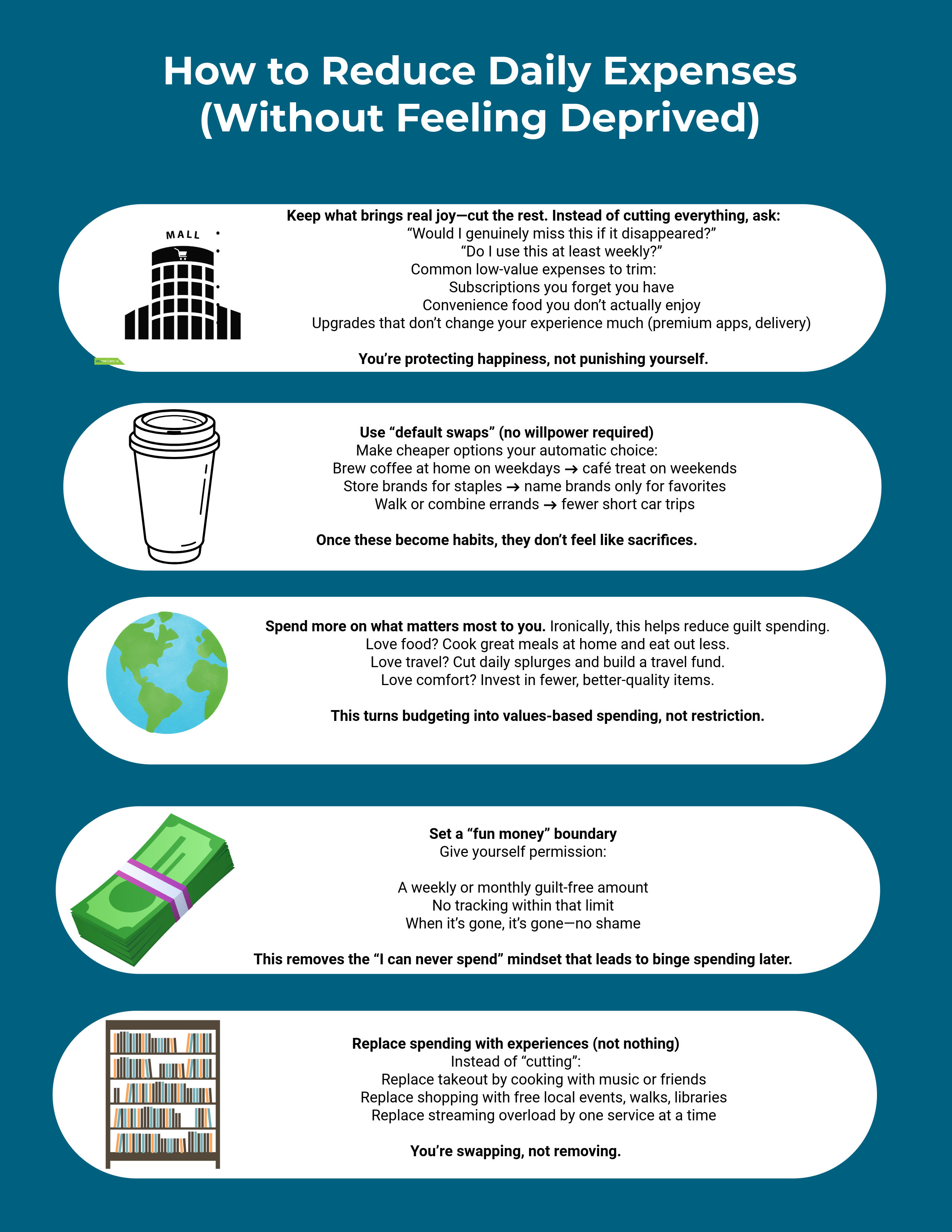
How to Stay Frugal Without Feeling Deprived
You want to spend less, save more, and still enjoy your life. That sounds simple until frugality starts to feel like a list of rules, skipped outings, and constant self-denial. How to stay frugal without feeling deprived matters because a budget only works if you can live with it for years, not two stressful weeks. The real trick is not squeezing every dollar until it squeals. It is learning which expenses actually improve your life and which ones quietly drain your money. That shift changes everything. You stop treating frugality like punishment and start using it as a filter for better choices. And once your spending lines up with what you value, saving gets easier, faster, and a lot less miserable.
What actually makes frugality stick
- Cut spending that adds little value before touching the things you truly enjoy.
- Build your budget around priorities, not guilt.
- Use small systems, like meal planning and waiting periods, to lower decision fatigue.
- Leave room for fun spending so your plan survives real life.
Why frugality feels hard in the first place
Most people fail at saving for a boring reason. They cut the wrong stuff. If you remove every treat, convenience, and social activity at once, your budget turns into a punishment plan.
That approach rarely lasts. A 2024 Bankrate survey found many Americans still live paycheck to paycheck, even at higher income levels. Income matters, sure, but spending choices and fixed costs matter just as much. If your money is tied up in habits and bills you do not care about, every month feels tight.
Look, deprivation usually comes from mismatch. You are spending on things you do not value enough, while telling yourself no on the things that keep life pleasant.
Good frugality is selective. It cuts hard in places that do not matter, so you can spend calmly where they do.
How to stay frugal without feeling deprived by finding your “enough”
This is where how to stay frugal without feeling deprived stops being theory. You need a clear picture of what “enough” looks like in your home, your schedule, and your bank account. Without that, every purchase becomes a debate.
Start with three questions:
- Which spending categories make daily life better?
- Which expenses feel automatic or forgettable?
- What financial goal matters enough to protect?
Maybe you love hosting friends, but do not care about a new car. Maybe takeout is your weak spot, but you happily wear secondhand clothes. Fine. Own that. Frugality works best when it is personal.
Think of it like packing a carry-on bag. Space is limited, so every item needs a reason to be there. Your budget works the same way.
Audit the low-value spending first
Before you cut the things you love, go after the quiet leaks. Subscription creep, impulse online orders, convenience fees, unused memberships, and pricey grocery habits often eat more cash than one big luxury purchase.
Try a 30-day spending review and sort each purchase into one of three groups:
- High value. You would gladly pay for it again.
- Neutral. Fine, but forgettable.
- Low value. You barely noticed it, or regret it.
That middle category is where a lot of waste hides. And the low-value section? That is your first target.
Honestly, this is the part many people skip because it is less exciting than a dramatic no-spend challenge. But it works better. A sustainable money plan is usually built on boring wins.
Use systems so willpower is not doing all the work
Willpower is shaky. Systems hold up. If you rely on motivation every day, your budget will wobble the second life gets busy.
Practical systems that lower spending
- Set a waiting period for non-essential purchases. Try 24 hours for small buys and 72 hours for bigger ones.
- Automate transfers to savings right after payday.
- Plan simple meals before grocery shopping.
- Keep a short price book for staples you buy often.
- Use a fixed fun-money amount each month.
One small rule can do a lot.
That single-sentence truth matters because smart money habits are often plain and repetitive. The Frugalwoods approach has long leaned on this idea. Daily choices, repeated often, beat grand plans that collapse by month two.
Protect a few spending categories on purpose
Here is the part budget advice often gets wrong. You should keep some spending that makes your life easier or happier. Yes, even while cutting back.
If a modest gym membership keeps you healthy, that may be worth more than random streaming subscriptions. If buying quality shoes prevents constant replacement, cheap is not actually cheap. If one planned dinner out each month helps you avoid weekly takeout binges, that is a solid trade.
Why force your budget to be joyless if that is exactly what makes people quit?
Use spending guardrails instead of blanket bans. For example:
- Coffee out once a week, not every day
- Travel from a sinking fund, not a credit card
- Books from the library first, bookstore second
- One convenience purchase during especially busy weeks
That is not being lax. It is being realistic (and realism keeps budgets alive).
How to stay frugal without feeling deprived in family life
How to stay frugal without feeling deprived gets trickier when other people are involved. Kids, partners, and relatives all bring different expectations around money. But the core rule stays the same. Focus on value, not appearances.
For families, some of the best savings moves are simple:
- Buy used for fast-changing needs like kids’ clothes and gear
- Choose low-cost routines such as library trips, potlucks, and park days
- Set gift budgets before birthdays and holidays
- Cook repeat meals everyone accepts, instead of chasing variety every night
And talk about trade-offs clearly. “We are skipping X so we can afford Y” lands better than “we cannot have nice things.” Tone matters.
The strongest family budgets are built on shared priorities, not silent resentment.
Watch out for the fixed-cost trap
Small savings help, but big recurring bills shape your financial life. Housing, transportation, insurance, and childcare usually do more damage than latte spending. If frugality feels impossible, look there first.
That may mean moving to a cheaper place, driving an older car, shopping insurance rates, or trimming paid services you built your routine around. None of that is flashy. But these are the decisions that create breathing room.
The Consumer Expenditure Survey from the U.S. Bureau of Labor Statistics consistently shows housing and transportation among the largest household expenses. That is why cutting only small daily treats often feels like running on a treadmill. You are moving, but not getting far.
A better end goal than “spend as little as possible”
The healthiest money habit is not extreme thrift. It is intentional spending. Spend less on autopilot purchases. Spend enough on what keeps life stable, useful, and enjoyable. Save the gap for goals that matter, whether that is debt payoff, emergency savings, early retirement, or simply less stress next month.
After years of covering personal finance, I trust this approach more than any dramatic reset. The people who do well with money are not always the harshest budgeters. They are the ones who know what they value and can ignore the noise.
So start there. Review your last month of spending, cut three low-value expenses, and protect one category you genuinely love. That is a better test than another punishing no-spend promise. And it is far more likely to hold up when real life barges in next week.